
Lolita
Vladimir Nabokov
4.3 on Amazon
40 HN comments

Heart of Darkness
Joseph Conrad
4.6 on Amazon
37 HN comments

Catch-22
Joseph Heller, Jay O. Sanders, et al.
4.4 on Amazon
37 HN comments

The Sun Also Rises: The Hemingway Library Edition
Ernest Hemingway
4.3 on Amazon
36 HN comments

The Odyssey
Homer , Robert Fagles, et al.
4.6 on Amazon
35 HN comments

On the Road
Jack Kerouac
4.3 on Amazon
33 HN comments

The Stranger
Albert Camus and Matthew Ward
4.6 on Amazon
32 HN comments

Ishmael:A Novel
Daniel Quinn
4.7 on Amazon
30 HN comments

American Gods: A Novel
Neil Gaiman
4.8 on Amazon
30 HN comments

Exhalation
Ted Chiang
4.6 on Amazon
24 HN comments

Mere Christianity
C. S. Lewis and Kathleen Norris
4.8 on Amazon
24 HN comments

The Remains of the Day
Kazuo Ishiguro
4.5 on Amazon
22 HN comments
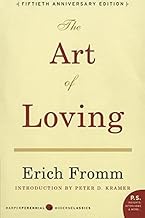
The Art of Loving
Erich Fromm
4.6 on Amazon
22 HN comments

World War Z: An Oral History of the Zombie War
Max Brooks
4.4 on Amazon
20 HN comments

The Stand
Stephen King, Grover Gardner, et al.
4.7 on Amazon
19 HN comments

mathiasrwonAug 3, 2016
https://en.wikipedia.org/wiki/The_Art_of_Loving
zipwitchonMar 31, 2015
let me tell you
this: someone in
some future time
will think of us”
― Sappho, The Art of Loving Women
ca98am79onJune 20, 2010
klbarryonJan 31, 2011
musageonNov 7, 2017
> If I had a friend and loved him because of the benefits which this brought me and because of getting my own way, then it would not be my friend that I loved but myself. I should love my friend on account of his own goodness and virtues and account of all that he is in himself. Only if I love my friend in this way do I love him properly.
-- Meister Eckhart
> If a person loves only one other person and is indifferent to all others, his love is not love but a symbiotic attachment, or an enlarged egotism. Yet most people believe that love is constituted by the object, not by the faculty. In fact, they even believe that it is proof of the intensity of their love when they do not love anybody except the "loved" person. [..] Because one does not see that love is an activity, a power of the soul, one believes that all that is necessary to find is the right object - and that everything goes by itself afterward. This attitude can be compared to that of the man who wants to paint but who, instead of learning the art, claims that he just has to wait for the right object - and that he will paint beautifully when he finds it.
-- Erich Fromm, "The Art of Loving" (1956)
yesenadamonDec 23, 2018
Escape from Freedom (also known as Fear of Freedom) is great, as are a lot of Fromm's books. He's my favourite psychologist, and by a long way favourite Frankfurt School writer. I also love Man for Himself, The Sane Society, To Have or To Be, The Art of Loving. He's wonderfully BS-free, combining insights into psychology, society, work, politics etc.
cllnsonJan 10, 2015
She frequently quotes Erich Fromm's The Art of Loving, which seems good as well.
[1]: http://en.wikipedia.org/wiki/All_About_Love:_New_Visions
[2]: http://en.wikipedia.org/wiki/The_Art_of_Loving
cloogshiceronJuly 23, 2019
The basic idea is that love and affection are not just feelings, but actual skills that need to be learned and cultivated.
It also introduces the distinction between being lovable and being loving.
HWIP largely teaches how to make yourself lovable, whereas the Art of Loving teaches the theory behind actively loving and embracing other people. I think it's a vital skill to have in any area of life, including business.
mbrockonJan 10, 2015
If a person loves only one other person and is indifferent to the rest of his fellow men, his love is not love but a symbiotic attachment, or an enlarged egotism. Yet most people believe that love is constituted by the object, not by the faculty. In fact, they even believe that it is proof of the intensity of their love when they do not love anybody except the "loved" person. This is the same fallacy which I have already mentioned above. Because one does not see that love is an activity, a power of the soul, one believes that all that is necessary to find is the right object - and that everything goes by itself afterward. This attitude can be compared to that of the man who wants to paint but who, instead of learning the art, claims that he just has to wait for the right object - and that he will paint beautifully when he finds it. If I truly love one person I love all persons, I love the world, I love life. If I can say to somebody else, "I love you," I must be able to say, "I love in you everybody, I love through you the world, I love in you also myself."
jackbravoonJune 13, 2014
rhblakeonJan 10, 2015
DamorianonJune 6, 2019
rsheehanonMay 27, 2018
A description of how love (romantic love, brotherly love, love for God, love for oneself) has to be actively practiced much like any other discipline and what the consequences are for individuals living in a society that by and large does not hold this belief. As a younger person who often gets frustrated with how easy it is to get caught up in his own narcissism and materialism, this book helped me better understand myself and what my core drives are moreso than anything else I’ve encountered to date. Only like 120 pages to boot.
graycatonDec 3, 2018
There's more: IIRC "The fundamental problem in life is getting security in the face of the anxiety from our realization that alone we are vulnerable to the hostile forces of nature and society.". The three top recommended solutions are "love of spouse, love of God, and membership in groups.". You don't want to consider the last alternative. E. Fromm, The Art of Loving.
LordNightonDec 24, 2020
Among the classic fiction the best so far were: T. Dreiser - The Bulwark, S. Maugham - Of Human Bondage, L. Tolstoy - The Kreutzer Sonata and E. Zola - l'Oeuvre & Germinal.
macawfishonMar 6, 2017
The Phenomenon of Science: A Cybernetic Approach to Human Evolution by Valentin Turchin
Paul's 1st letter to the Corinthians
History, Guilt & Habit by Owen Barfield
The Prophet by Khalil Gibran
Dawn by Octavia Butler
Snow Crash by Neal Stephenson
You Are Here by Thich Nhat Hanh
The Art of Loving by Erich Fromm
Nonviolent Communication by Marshall Rosenberg
The Little Prince by Antoine de Saint-Exupéry
graycatonJan 1, 2015
We want a solution to the fundamental problem of life,
that is, doing something effective about feeling alone.
Or, one step deeper, we seek security from the
anxiety from our realization that alone
we are vulnerable to the hostile forces of nature
and society.
Only four solutions have been found effective,
love of spouse, love of God, membership in
a group, and one more not recommended.
Paraphrased from E. Fromm, 'The Art of Loving'.
Simple enough.
Bet the Amish do relatively well on the above.
collinglassonAug 8, 2016
It's my grandmas favorite non-fiction and she's read over 1000 books. She gave it to me and it sat on my shelf for months because the title wasn't appealing and I'm not a big book reader. Since I read it, I've now bought a second version of this book and give it to friends to read.
It's a technical write-up about Love in the general sense. Fromm pitches the idea that love is an art rather than a feeling.
I highly recommend the read. This book discusses the topic in a serious and insightful way.
graycatonJune 23, 2013
one of the best things I ever read.
He explained a lot to me about
people, motivations, personality,
women, etc. A lot. Some of
his explanations were shockingly
succinct but from decades of
my checking empirically right on
target.
To me in that book, he is fully
credible. I can guess how he got
the insights: Be a bright guy,
have a good background in what
was known, at least empirically,
at the time about psychology and
psychiatry,
do a lot of clinical psychology,
listen to a lot of people, and identify
the main issues and forces in
common. Now I can look at
events A, B, and C, from Fromm find
the intuitive, qualitative version of the
conditional probability of
event X given events A, B, and
C -- P(X}A, B, C) -- when this
conditional probability is high, take X
as a candidate explanation, look
at some more data, and often
conclude that Fromm nailed it again.
graycatonMar 6, 2017
of the Calculus of Probability,
Holden-Day, San Francisco.
Random variables and the associated
probability theory and conditional
probability theory are surprisingly
relevant, especially now with computing,
in the real world. That the set of real
valued random variables X such that E[X^2]
is finite forms a Hilbert space, e.g., is
complete, is astounding. So is the
martingale convergence theorem.
Erich Fromm, The Art of Loving.
Heavily about how what people do is in
response to the anxiety they feel from the
realization that alone they are vulnerable
to the hostile forces of nature and
society.
a_bonoboonMay 12, 2020
Erich Fromm's The Sane Society - on how society impacts people's mental health, and how to build towards a sane society
Fromm's The Art Of Loving - an analysis of different kinds of loves, trying to dispel pop culture's lies about love, and love is actually hard work
Ernest Becker's The Denial of Death - on how not our fear, but our complete denial of death existing leads to the weirdest outcomes in our society
Then there's political stuff -
Orwell's Essays, any large-ish collection. I find Orwell to be a much, much better non-fiction writer than fiction writer. Extremely insightful into political processes.
Robert Caro's books, perhaps the first The Years Of Lyndon B Johnson. Can't get better insights into how power works on a local and not-so-local level.
Popper's Open Society and its enemies, hard to summarise - a defense of Western society in light of the then-ongoing WW2. You probably saw the paradox of tolerance a few times pop up, that's from that book, among a ton of other stuff.
thingsilearnedonJan 8, 2009
Don't be hard on yourself that you haven't changed after just 6 days. Making a major change to your personality takes some time. I suggest re-reading the book every once in a while to keep the goal fresh in your thoughts.
Also I recommend Erich Fromm's "The Art of Loving" which briefly discusses Carnegie's book and gives more of a "why" than a "how" on dealing with people.