
Understanding Comics: The Invisible Art
Scott McCloud
4.7 on Amazon
22 HN comments

The Iliad
Gareth Hinds
4.8 on Amazon
22 HN comments
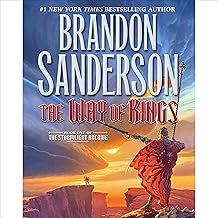
The Way of Kings: The Stormlight Archive, Book 1
Brandon Sanderson, Kate Reading, et al.
4.8 on Amazon
15 HN comments

The Lies of Locke Lamora: Gentleman Bastard, Book 1
Scott Lynch, Michael Page, et al.
4.5 on Amazon
15 HN comments

Artemis
Andy Weir, Rosario Dawson, et al.
4.2 on Amazon
15 HN comments

Watership Down
Richard Adams, Peter Capaldi, et al.
4.7 on Amazon
14 HN comments

Live: Remain Alive, Be Alive at a Specified Time, Have an Exciting or Fulfilling Life
Sadie Robertson Huff and Beth Clark
4.9 on Amazon
13 HN comments
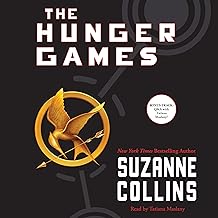
The Hunger Games: Special Edition
Suzanne Collins, Tatiana Maslany, et al.
4.7 on Amazon
12 HN comments

Apple: (Skin to the Core)
Eric Gansworth
4.4 on Amazon
12 HN comments

1776
David McCullough and Simon & Schuster Audio
4.7 on Amazon
11 HN comments

Women in Science: 50 Fearless Pioneers Who Changed the World
Rachel Ignotofsky
4.8 on Amazon
11 HN comments

The Phantom Tollbooth
Norton Juster and Jules Feiffer
4.8 on Amazon
9 HN comments

Life of Pi
Yann Martel
4.4 on Amazon
9 HN comments

Fable: A Novel (Fable, Book 1)
Adrienne Young, Emma Lysy, et al.
4.6 on Amazon
8 HN comments

The Boy Crisis: Why Our Boys Are Struggling and What We Can Do About It
Warren Farrell PhD and John Gray PhD
4.7 on Amazon
7 HN comments

TcepsaonFeb 28, 2012
paulhauggisonMar 24, 2012
Is it well below my level? Yes, but it was a good story.
PerditiononFeb 28, 2014
Anyone who argued that men couldn't enjoy The Hunger Games by Suzanne Collins because the protagonist is a women would be laughed at.
gaiusonFeb 16, 2018
Start with The Hunger Games and if she likes it that’s next year sorted too, buy her a bow.
bryanrasmussenonJuly 24, 2020
alexanderbermanonDec 27, 2011
* Boomerang by Michael Lewis
* Steve Jobs by Walter Isaacson
* The Hunger Games by Suzanne Collins
* The Thank You Economy by Gary Vaynerchuk
civilianonMay 22, 2015
_deliriumonJuly 1, 2012
icarus_drowningonMay 17, 2012
For example: during our standardized testing this year, the school put in huge amounts of effort to align student incentives, most of which were silly and clearly ineffective. (My personal favorite? Disallowing students to bring their own books to read after they finished the test to "encourage" them to check their work instead of hurrying through so they could read the next chapter of The Hunger Games. Talk about easy ways to incite student frustration and contempt!)
I can attest to students finishing a test in less than 10 minutes despite being given more than an hour, or refusing to do any of the test at all. I've heard horror stories of students using the multiple-choice answer documents to make pictures by filling in the bubbles, or simply choosing to color in bubbles so lightly that they can't possibly be read. I know of examples in prior years wherein students chose to write essays about how much they hate testing on the essay portion instead of addressing the infantile tripe they were assigned.
Now, these are obviously exceptions to the rule (I'm a bit biased, but I think our students are almost uniformly excellent), but it is amazing how much damage one student can do by choosing not to care. (Or, in some cases, using their answers to vent their frustration).
And why should they? As far as I know, rewarding students for higher performance is disallowed, leaving teachers with very few tools with which to convince students that these tests matter. Sure, you can go on and on about how their scores will be "important" in their future (which, to my knowledge, isn't always true), but that only goes so far. Sometime during the 2 weeks of intensive testing, the kids just don't care anymore.
I'm all for assessing the performance of teachers, and I'm not sure how to fix the problem (or even if it can be fixed), but one thing seems clear to me: they're doing it wrong.
[Updated to fix punctuation errors]
SiValonDec 11, 2015
lancewiggsonAug 2, 2014
The Match King
Heros Die (I bought the rest of them)
The city and the city
Every patient tells a story
Blindsight
Born to Run
Hot, Flat & Crowded
The Autobiography of Ben Franklin
The Hunger Games (!)
And on it went - asking for recommendations was a fantastic thing to do. I'd asked for fiction as I was going there to work and would be too exhausted at first to do much else.
So I do encourage everyone to give some names of books. And yes - do take a good camera, do take binoculars - Leica if you can afford them, and embrace the experience.
A few years later I went to Antarctica on a boat for 30 days offline. By then I had hundreds of books on kindle, and several devices to read them. This is basically a solved problem now. I did take Wikipedia in offline state, which was useful.
In decades previous when traveling I cared about weight and price per word and focused on "good" books - books that you know you should read but which need a bit of effort. When you are off the grid and in countries where there are few English books then it was a great way to read great books.
But now the Internet is everywhere. It might be flaky, and it might be painful to access, but you'll be able to find access to buy and download books relatively easily.
Three recommendations, aside from the above which I enjoyed a lot.
Bill Aulet: Disciplined Entrepreneurship, covers the topic very well and generously references everything else.
The Circle by Dave Eggers paints a picture that's creepily familiar already.
League of Denial will have you shake your head gently and sadly at NFL and other contact sports.
TheOtherHobbesonMar 27, 2015
I know a super-smart fourteen year old. He tells me The Hunger Games and Harry Potter are the best books he's read.
When I was in my teens I was reading:
Herman Hesse
Thomas Mann
John Barth (which shows how old I am...)
John Irving
John Updike
Doris Lessing
A lot of SF, classic/mainstream and otherwise
Literal piles of electronic and computer hobby mags
OMNI magazine
Articles in Encyclopedia Britannica about tensor analysis and simultaneity which I totally failed to understand
A buy-weekly-and-keep popular subscription encyclopedia I talked my parents into getting for me.
Of those, OMNI made the biggest impression because it hit an art/science/futurism sweet spot that I haven't seen copied since. (Mondo 2000 was on a different moon of the same planet. Wired is a very poor imitation.)
The buy-weekly encyclopedia was unexpectedly useful too, because it covered things like art history and politics I'd never have thought about otherwise.
I think 14 is as much about curiosity, creativity and emotions as raw intellect. So if you're just creating a reading list about stuff to think about in a clever way, you're going to be missing a lot of potential for more rounded development.
I'd think about experiences as well as books. Go to sports. Go to an opera. Go to art galleries. Go see bands. Travel and have adventures. Go to a political debate. Go see some classical Greek tragedy or comedy. Couch surf with strangers and take the kid along. Go hiking a long way from the Internet. Teach some survival skills.
If the 14 yo doesn't want to have the fam along, offer free tickets and travel for them and friends. (Not so much for the travel...)
And so on. Leave the compiler theory books for later.