
Understanding Comics: The Invisible Art
Scott McCloud
4.7 on Amazon
22 HN comments

The Iliad
Gareth Hinds
4.8 on Amazon
22 HN comments
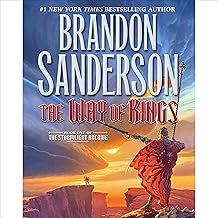
The Way of Kings: The Stormlight Archive, Book 1
Brandon Sanderson, Kate Reading, et al.
4.8 on Amazon
15 HN comments

The Lies of Locke Lamora: Gentleman Bastard, Book 1
Scott Lynch, Michael Page, et al.
4.5 on Amazon
15 HN comments

Artemis
Andy Weir, Rosario Dawson, et al.
4.2 on Amazon
15 HN comments

Watership Down
Richard Adams, Peter Capaldi, et al.
4.7 on Amazon
14 HN comments

Live: Remain Alive, Be Alive at a Specified Time, Have an Exciting or Fulfilling Life
Sadie Robertson Huff and Beth Clark
4.9 on Amazon
13 HN comments
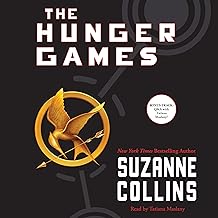
The Hunger Games: Special Edition
Suzanne Collins, Tatiana Maslany, et al.
4.7 on Amazon
12 HN comments

Apple: (Skin to the Core)
Eric Gansworth
4.4 on Amazon
12 HN comments

1776
David McCullough and Simon & Schuster Audio
4.7 on Amazon
11 HN comments

Women in Science: 50 Fearless Pioneers Who Changed the World
Rachel Ignotofsky
4.8 on Amazon
11 HN comments

The Phantom Tollbooth
Norton Juster and Jules Feiffer
4.8 on Amazon
9 HN comments

Life of Pi
Yann Martel
4.4 on Amazon
9 HN comments

Fable: A Novel (Fable, Book 1)
Adrienne Young, Emma Lysy, et al.
4.6 on Amazon
8 HN comments

The Boy Crisis: Why Our Boys Are Struggling and What We Can Do About It
Warren Farrell PhD and John Gray PhD
4.7 on Amazon
7 HN comments

kylecordesonMar 3, 2017
spdionisonJune 1, 2016
noobymatzeonSep 17, 2015
The one from Fable actually seems to be an alteration as well, giving me about the same idea about the content as knowing the actual reference would have. Fun stuff.
DanielBMarkhamonFeb 1, 2021
I want to provide a little nuance around this, because I'd give the opposite advice.
Because F# is based on OCAML and an extremely popular IDE/framework, it is first and foremost a teaching language. In my opinion, for what it's worth, the biggest mistake other F# coders make is running off into Haskell-land and trying to drag the rest of the community with them. Yes, pure FP is love and goodness, joy and love, but that's not the place to start with your average coder who just wants to see what's cool. Fable and Elmish are
I learned functional programming by reading a lot of OCAML books and the only(!) F# book out at the time. I coded like shit. I couldn't help it; I came from a strong OO background.
But then I figured out that instead of coding everything perfectly, it was more important to finish a little bit at a time, then take a look at functional smells, things like mutation. Sometimes I could fix these smells, sometimes I couldn't. Over time I found I could fix all of them. At that point I was a functional programmer.
I love these high-level F# frameworks, and like I said it's the best way to get folks involved, but wow, folks are going to create some programming disasters using them. Yes, this happens all the time withe every new thing, but functional messes are an order-of-magnitude worse than imperative/OO ones. Good luck, guys! The destination is worth the journey.
dustinmorisonJan 17, 2018
jtbigwooonSep 5, 2014
It has to do with the way we train people to write books as opposed to how we train people to make video games. English degree programs often spend as much time on literary theory as they do on the practical aspects of composition. Most CS and video game design programs are almost entirely practical. I think this has allowed literature to move alongside and even in front of the culture at large while video games lag the rest of the culture.
Maybe this explains why we've gotten used to plenty of topics and themes in books that are still stunning in video games. Think about how shocking it was to some people that we could play a gay character in Fable or Bully. Nobody even notices when a best seller has a gay protagonist.
william-newmanonJan 19, 2010
Incidentally, I would be very interested in a pointer to a comparably serious/academic rebuttal of Fable of the Keys. It has been a very long time since Fable of the Keys was published, and it has been a long time since I last tuned into the controversy, and at that time my understanding was that a rebuttal had long been promised but never produced.
RadixonDec 30, 2008
And still, the industry hasn't failed to be "emotionally dense", which must mean 'invoking emotion'. I remember playing MGS:2 SoL and being quite affected during the scene where Emma dies, even with, what i recall, poor voice acting. I also remember feeling all kinds of emotions when playing Earthbound. I remember empathizing with Ness when he was homesick. And looking back with a strange sense of accomplishment when I stopped for coffee a third of the way through. In short, games are different, and when they're meant to have some emotional impact, it happens differently than in film or literature. And unless you're used to the medium and attaching yourself to a character you might overlook what a game really is.
(I can try an' be pretentious too. I'm not annoyed by the subject of the article, just the author, and Ebert.
But the following has been at the heart of several games. Really, has the author never heard of Fable? It at least tried.
"Mistakes you make, early on, haunt you through some game mechanic later."..."It's not going to coddle: awesome job!" )