Adventures of Huckleberry Finn
Mark Twain
4.6 on Amazon
12 HN comments
It
Stephen King, Steven Weber, et al.
4.7 on Amazon
12 HN comments

Invisible: A Novel
Danielle Steel
4 on Amazon
12 HN comments
Dark Matter: A Novel
Blake Crouch
4.5 on Amazon
12 HN comments

Leviathan Wakes
James S. A. Corey
4.7 on Amazon
12 HN comments

American Psycho
Bret Easton Ellis, Pablo Schreiber, et al.
4.5 on Amazon
11 HN comments

The Overstory: A Novel
Richard Powers
4.4 on Amazon
11 HN comments

The Fifth Season: The Broken Earth, Book 1
N. K. Jemisin, Robin Miles, et al.
4.5 on Amazon
11 HN comments
And Then There Were None
Agatha Christie
4.5 on Amazon
11 HN comments

All Quiet on the Western Front
Erich Maria Remarque, Frank Muller, et al.
4.7 on Amazon
11 HN comments

1Q84
Haruki Murakami, Allison Hiroto, et al.
4.4 on Amazon
10 HN comments

The Kite Runner
Khaled Hosseini
4.7 on Amazon
10 HN comments
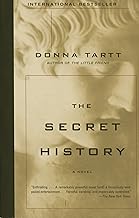
The Secret History
Donna Tartt
4.3 on Amazon
10 HN comments

Gone Girl
Gillian Flynn
4 on Amazon
10 HN comments

Beloved
Toni Morrison
4.5 on Amazon
9 HN comments

Ar-CurunironAug 8, 2016
delluminatusonFeb 26, 2015
If you want to read an actual novel by him, I highly recommend 1Q84, which is an engaging and somewhat surreal story.
booleandilemmaonMar 29, 2020
My least favorite book of all time has to be The Physiognomy by Jeffrey Ford.
MengerSpongeonJuly 20, 2020
Although with a little more thought, 1Q84 might be more upsetting now than it was last year.
_jdamsonAug 8, 2017
Side comment, but somewhat related: I just started getting into reading and the most recent book I finished was Kafka on the Shore by Haruki Murakami. I just started 1Q84, also by Murakami. Those books really do something to my brain when I read them. Ever since I got into it, I've had these strange desires to write a book of my own, but since I have no experience in the matter, I was thinking of clever ways to procedurally generate plot points, then let a randomizer run in a loop until it generates something interesting.
For example, in multiple arrays, you could create lists for different plot elements: ex: "main character is a " [student, engineer, pilot, detective]. You can do something for physical features as well, and personality traits, and generate completely randomized characters. Then, you could do something for the plot as well... If I were able to do this as a starting point, I could write a story by filling in the blanks, so to speak...
So, is there a popular forum or perhaps Twitter that all of these enthusiasts hang out at? =D
theseadroidonDec 27, 2018
During college there's no mandatory literature courses anymore but I was exposed to many western work during that time in my spare time. One reason was I was trying hard to learn English. But I can see many people dont have the incentives to read those even if those works are famous even in China. Many STEM college students in China start to prep for studying overseas once they step into college and all they care is GPA + a good Toefl/GRE score (and there are faster ways of getting good scores for those other than reading literature).
I dare to say many of those STEM students become the friends and coworkers you guys have in US today and they probably haven't "wasted" much time on pondering issues outside of STEM fields or getting their own lives to a better place.
Edit: not appearing in literature textbooks doesn't mean it's not famous or popular in mainland China. Haruki Murakami is also a very popular author whose work is not included in textbooks. He has a book called 1Q84 which was very popular and many Chinese got interested in 1984 because of it.
titanix2onJune 20, 2018
For text in Japanese I only read a few pages in class and during exam and that wasn't relevant to my interest either: the style is flat and he use to many loan words from English. Up to that point I wonder where his success come from because I really don't get the appeal of his work (from what I read).
Ar-CurunironJune 21, 2018
bathMarm0tonMar 29, 2020
atombenderonJune 20, 2018
I think one thing that sets Murakami apart is the earnest simplicity of his writing. His writing seemingly doesn't attempt to manipulate the reader, and it doesn't seem to aim beyond high school English in complexity. It's workmanlike, unaffected, and personal. To me, it brings to mind John Williams (Stoner) and Karl Ove Knausgaard (who is admittedly a much more capable prose stylist).
In his earlier works, the simplicity feels a bit... simple. But in hi later, more mature works, he doesn't shy away from going into detail about the sheer mundaneness of living. I haven't read 1Q84, but the first book to really deserve the stereotype of Murakami as being about single guys with cats lounging about in empty apartments while waiting for the pasta to boil is The Wind-Up Bird Chronicle, the core theme of which is figuring out reality, and by the extension, life. It's a work where the economy of style meets an economy of plot (even though it's actually a complex plot!) perfectly, and it's a masterpiece.
I've never been to Japan, but I find his other concerns you mention — isolation and so on — to be just as relevant in other social-democratic cultures (perhaps the US less so).