Adventures of Huckleberry Finn
Mark Twain
4.6 on Amazon
12 HN comments
It
Stephen King, Steven Weber, et al.
4.7 on Amazon
12 HN comments

Invisible: A Novel
Danielle Steel
4 on Amazon
12 HN comments
Dark Matter: A Novel
Blake Crouch
4.5 on Amazon
12 HN comments

Leviathan Wakes
James S. A. Corey
4.7 on Amazon
12 HN comments

American Psycho
Bret Easton Ellis, Pablo Schreiber, et al.
4.5 on Amazon
11 HN comments

The Overstory: A Novel
Richard Powers
4.4 on Amazon
11 HN comments

The Fifth Season: The Broken Earth, Book 1
N. K. Jemisin, Robin Miles, et al.
4.5 on Amazon
11 HN comments
And Then There Were None
Agatha Christie
4.5 on Amazon
11 HN comments

All Quiet on the Western Front
Erich Maria Remarque, Frank Muller, et al.
4.7 on Amazon
11 HN comments

1Q84
Haruki Murakami, Allison Hiroto, et al.
4.4 on Amazon
10 HN comments

The Kite Runner
Khaled Hosseini
4.7 on Amazon
10 HN comments
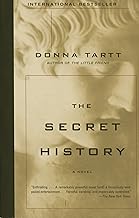
The Secret History
Donna Tartt
4.3 on Amazon
10 HN comments

Gone Girl
Gillian Flynn
4 on Amazon
10 HN comments

Beloved
Toni Morrison
4.5 on Amazon
9 HN comments

stickfigureonJan 26, 2021
The only thing I can imagine is that they do an incredible amount of activity tracking.
bluewavescrashonDec 12, 2018
* The Goldfinch -- Donna Tartt
* Hotel New Hampshire -- John Irving
* A Prayer For Owen Meany -- John Irving
* Wonder -- R.J. Palacio
* Adventures of Huckleberry Finn -- Mark Twain
* The Elegance of the Hedgehog -- Muriel Barbery
Irving and Tartt are my favorite.
thescriptkiddieonFeb 27, 2017
DoubleCribbleonJune 16, 2017
Liberated? That ephemera might actually be integral to the story and you are NOT the arbiters of intent. Please keep your modernizing out of my lit'ratur.
[1]Pap, The Adventures of Huckleberry Finn
gamacheonDec 24, 2008
falcolasonMar 17, 2021
YA, as pointed out in sister threads, includes books like Catcher in the Rye, The Hobbit, Ender's Game, Adventures of Huckleberry Finn, and so forth. Stereotypes like this one hurt these discussions quite a bit. Stereotypes also prevent people from reading good books.
> Young adults would be better served by ignoring YA in favor of the wider book world
I might agree with you if it was only authors who were intentionally targeting those genres. It's not. Publishers will take general books and market them as YA. I know of some really good authors who have been shoehorned into the YA market (Forthright, as one example).
> books written before the YA genres existed
YA has been around for over 200 years now. The YA category (as opposed to children's) came about around 1802 (per Wikipedia).
a3voicesonSep 27, 2015
jerome-jhonMar 6, 2020
auxymonApr 21, 2015
Anna Karenina (Leo Tolstoi): Intertwined tales about love and finding happiness that simply feels timeless. I think Tolstoi's greatest achievement is making the characters feel so human in this. For what it's worth i did not find it a difficult or heavy read at all.
The Brothers Karamazov (Dostoyesky): Them russians really have something with humanness. Where Anna touches love and happiness, karamazov contrasts religion and ethics, faith and reason. Once again, it feels like it could have been written today and still be as relevant.
1984, Orwell. Don't think I need to go into this one, but every time i read it, I find something. This novel was really deeply thought out, inventions like doublespeak really makes you think about how we think about and react to politics.
I realize most of those are likely required reading in american high schools, which to me is proof that your public school system is not entirely lost. I wish we had read some actual substantial texts in my schooling and didn't have to discover these in my early 20s.
peterwwillisonMar 30, 2012
The word itself causes no harm. Tell a child a curse word they don't know and they aren't stricken back as if you had slapped them. It has no meaning or value until you describe what it means and when to use it. Then once it's explained to them, assuming they weren't harangued by their parents into fearing the word itself, there's the use in a book such as The Adventures of Huckleberry Finn:
"Oh, yes, this is a wonderful govment, wonderful. Why, looky here. There was a free nigger there from Ohio – a mulatter, most as white as a white man. He had the whitest shirt on you ever see..."
Contrast this with a book like Where The Red Fern Grows, where a boy's dog (who he loves dearly) is disemboweled in front of him and he has to literally stuff his intestines back into the dog's bloody carcass.
If the high purpose is indeed to protect children they should be taught about the world so they'll know how to deal with it. Sure, there's ugly things about the world and for the most part we try to isolate ourselves from it, but burning it doesn't make it go away. The end result may be it enforces in the child the idea that they can choose to destroy any part of society they dislike, regardless of anyone else's opinion and without a reason other than their feelings. Personally I can't think of anything more frightening.
dublinbenonMay 28, 2014
This is only because publishers enjoy an artificial monopoly on the production of specific works thanks to copyright. Without these limits, you would see a free market in competing editions of the same books, such as exists for books in the public domain.
The Iliad: http://www.amazon.com/s/ref=nb_sb_noss_1?url=search-alias%3D...
Adventures of Huckleberry Finn: http://www.amazon.com/s/ref=a9_asi_1?rh=i%3Aaps%2Ck%3Ahuckle...
neildonJuly 19, 2011
Eche of theym sholde ... make theymselfe redy. — Caxton, Sonnes of Aymon (c. 1489)
Arise; one knocks. / ... / Hark, how they knock! — Shakespeare, Romeo and Juliet (c. 1595)
'Tis meet that some more audience than a mother, since nature makes them partial, should o'erhear the speech. — Shakespeare, Hamlet
I would have everybody marry if they can do it properly. — Austen, Mansfield Park (1814)
That's always your way, Maim—always sailing in to help somebody before they're hurt. — Mark Twain, Adventures of Huckleberry Finn (1884)
Caesar: "No, Cleopatra. No man goes to battle to be killed." / Cleopatra: "But they do get killed". — Shaw, Caesar and Cleopatra (1901)
The singular "they" has extensive precedent. Some proscriptive grammarians feel that it should be disallowed, but given the usefulness of a neutral pronoun and the venerable history of the usage, I think they may be safely ignored.