
The Screwtape Letters
C. S. Lewis
4.7 on Amazon
18 HN comments

A Farewell to Arms: The Hemingway Library Edition
Ernest Hemingway , Sean Hemingway, et al.
4.5 on Amazon
17 HN comments

Good Omens
Neil Gaiman, Terry Pratchett, et al.
4.7 on Amazon
17 HN comments

Shantaram: A Novel
Gregory David Roberts, Humphrey Bower, et al.
4.6 on Amazon
16 HN comments
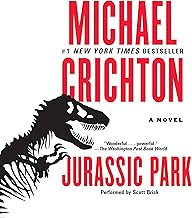
Jurassic Park: A Novel
Michael Crichton, Scott Brick, et al.
4.8 on Amazon
16 HN comments

Fight Club
Chuck Palahniuk, Jim Colby, et al.
4.7 on Amazon
15 HN comments

Twilight: The Twilight Saga, Book 1
Stephenie Meyer, Ilyana Kadushin, et al.
4.7 on Amazon
15 HN comments

Dune Messiah
Frank Herbert
4.5 on Amazon
14 HN comments

Cat's Cradle: A Novel
Kurt Vonnegut
4.6 on Amazon
14 HN comments

Midnight: A Gangster Love Story (1) (The Midnight Series)
Sister Souljah
4.7 on Amazon
14 HN comments

Born a Crime: Stories from a South African Childhood
Trevor Noah and Audible Studios
4.8 on Amazon
13 HN comments

The Broken Earth Trilogy: The Fifth Season, The Obelisk Gate, The Stone Sky
N. K. Jemisin
4.7 on Amazon
13 HN comments

Recursion: A Novel
Blake Crouch
4.5 on Amazon
13 HN comments

Leviathan Wakes
James S. A. Corey
4.7 on Amazon
12 HN comments

The Things They Carried
Tim O'Brien
4.5 on Amazon
12 HN comments

Nicholas_ConNov 8, 2013
Also reading A Farewell to Arms.
DoreenMicheleonAug 24, 2019
-- Ernest Hemingway, A Farewell to Arms
baud147258onNov 11, 2019
etanazironMar 16, 2014
― Ernest Hemingway, A Farewell to Arms
lostloginonJan 14, 2013
infectoidonFeb 3, 2014
> While working, he used a typewriter to copy F. Scott Fitzgerald's The Great Gatsby and Ernest Hemingway's A Farewell to Arms in order to learn about the writing styles of the authors.
Source: http://en.wikipedia.org/wiki/Hunter_S._Thompson#Early_journa...
necessityonDec 23, 2015
Ernest Hemingway's "A Farewell to Arms": While reading it I found it extremely boring, though there was this feel to it that still made it pleasant to read. I can't really describe it.
Plutarch's "Lives" from the main figures from the end of the Republic (Penguin Classics collection): By far the best books on Roman history I've ever read.
Livy's books on the Second Punic War (Penguin Classics collection): A bit extensive, very detailed. I liked Plutarch's better (even though he's a bit more imaginative according to modern historians), but nevertheless a great read.
Various books by Machado De Assis (Quincas Borba, Helena, among others): National author, I just love his books, even though they all share a common plot.
A book on Alexander the Great. Can't remember the author. It was a summary of his life and conquers, very short but entertaining reading.
This year I'm planning to read some more Ancient History narrated by the classics, some Shakespeare and maybe Nietzsche or Dante (heavy reading I guess). I'm just as fond of history as of fiction, as Livy puts it:
I shall find in antiquity a rewarding study, if only because, while I am absolved in it, I shall be able to turn my eyes from the troubles which for so long have tormented the modern world...
Jun8onDec 14, 2012
"During this time he worked briefly for Time, as a copy boy for $51 a week. While working, he used a typewriter to copy F. Scott Fitzgerald's The Great Gatsby and Ernest Hemingway's A Farewell to Arms in order to learn about the writing styles of the authors."
jemani_oneonSep 13, 2018
Personally, A Farewell to Arms has likely caused the biggest change. I became really absorbed in the book and at the same time in life was expecting my first child. I didn’t know the story at all, and was not expecting the ending in the least.
There have been many things in life that have taught me to enjoy what I have because it can all be gone in an instant. But that book combined with where I was in life cemented the lesson.
I’m interested in how Man’s Search caused a change in your life.
SHOwnsYouonSep 24, 2010
I keeping editing as I think of new things. This may sound odd, but if they are in the 14+ range, How to Win Friends and Influence People is great. It changed a lot for me.
When I was like 9 I got the book How to be Twice as Smart and it taught me a ton of mental tricks.
This book taught me a lot (probably if the boy is like 10 or 12+?)
http://www.amazon.com/Backyard-Ballistics-Cannons-Cincinnati...
sgorayaonAug 2, 2010
For whom the bell tolls & A farewell to arms
Out of those two, I liked For Whom The Bell Tolls a little bit better.
wombatmobileonJuly 19, 2021
Separate to idiom is the process of rewriting, whereby rough thoughts are honed to sharp points.
“I have rewritten — often several times — every word I have ever published. My pencils outlast their erasers.”
― Vladimir Nabokov
“Revision means throwing out the boring crap and making what’s left sound natural.”
― Laurie Halse Anderson
“Secure writers don't sell first drafts. They patiently rewrite until the script is as director-ready, as actor-ready as possible. Unfinished work invites tampering, while polished, mature work seals its integrity.”
― Robert McKee
“When asked about rewriting, Ernest Hemingway said that he rewrote the ending to A Farewell to Arms thirty-nine times before he was satisfied. Vladimir Nabokov wrote that spontaneous eloquence seemed like a miracle and that he rewrote every word he ever published, and often several times. And Mark Strand, former poet laureate, says that each of his poems sometimes goes through forty to fifty drafts before it is finished.”
― Susan M. Tiberghien, One Year to a Writing Life: Twelve Lessons to Deepen Every Writer's Art and Craft
“I do so much writing. But so much of it never goes anywhere, never sees any light of day. I suppose that's like gardening in the basement. I don't publish so much of what I write. I just seem to plow it back into the soil of what I write after it, rewriting and rewriting, thinking that somehow it gets better after the fifty-second-time around. I need to learn to abandon my writing. To let go of it. Dispose of it, like tissue.”
― J.R. Tompkins
“Writing a first draft is like groping one's way into a dark room, or overhearing a faint conversation, or telling a joke whose punchline you've forgotten. As someone said, one writes mainly to rewrite, for rewriting and revising are how one's mind comes to inhabit the material fully.”
― Ted Solotaroff
csenseonFeb 14, 2014
He's an awful writer. I couldn't stomach his writing style long enough to finish A Farewell to Arms when I was supposed to read it in high school.
If his work wasn't in a book that was professionally printed and bound, I'd have mistaken it for the scribblings of some amateur hack -- maybe one of the students who didn't make it into AP English, because the writing quality was kinda mediocre-to-poor.
Dickens, OTOH, is a master of language -- creating long and complex sentences, filled of description and analogy, which have a rich diversity of adjectives and adverbs, creating a descriptive, witty prose.
I've never understood why people like Hemingway.
cafardonJune 10, 2015
I haven't read much in years, but some time ago, I opened A Farewell to Arms, and I must say that the first few pages are beautifully written.
ghaffonJan 6, 2021
I'm not sure why schools tend to fixate on that particular work. Hemingway may not be to your taste anyway but I much prefer A Farewell to Arms, A Moveable Feast, many of his short stories, etc.
csenseonFeb 13, 2014
I couldn't stomach his writing style for an entire novel, so I ended up not finishing the book.
I would like to see someone make a similar website to guide you toward writing in the style of Charles Dickens.
calebmonDec 19, 2017
* Never Let Me Go (Kazuo Ishiguro)
* Influx (Daniel Suarex)
* Sputnik Sweetheart (Haruki Murakami)
* Apex (Ramez Naam)
* One Second After (William R. Forstchen)
* Anna Karanina (Leo Tolstoy)
* Neuromancer (William Gibson)
* A Farewell to Arms (Ernest Hemingway)
* Crux (Ramez Naam)
* A Moveable Feast (Ernest Hemingway)
* Hardboiled Wonderland and The End of the World (Haruki Murakami)